Acceptance rate within 24 hours
4.86% → 5.23%
*Data for one week after deployment
서비스 구축
Role: Product Designer, PM

In this piece, I want to introduce the moving service we've been building recently. Moving service is a somewhat different territory from browsing home-styling content or buying interior products — it's a product that only works if you satisfy two sides at once, partners and customers. This piece is about the process of finding the point where both sides are satisfied.
Whenever people hear that Ohouse is building a moving service, we often get questions like:
"Isn't moving outside your usual category?"
"Why would an interior platform get into moving?"
"Isn't moving just about who's cheapest?"
These are half right, half wrong. What our team wanted to solve wasn't simply building a service that brokers moves — it was drip pricing, a problem that's existed in the moving market as standard practice for a long time.
Drip pricing is the phenomenon where the quote you're first given and the final amount you're actually charged don't match. It's naturally an unpleasant experience for customers, and a chronic problem that erodes trust in the market as a whole.
This wasn't something product experience improvements alone could fix. The business had to move alongside it. So Ohouse adopted a "Guaranteed Responsibility" (책임보장) model, directly vetting and collaborating with partners — because we believed customers should be able to feel the same service quality they expect from Ohouse when buying furniture, in the moving service too.
At first glance, "why would Ohouse get into moving?" might seem like a fair question. But Ohouse is exactly where the flow of styling a home and researching interior work naturally converges. If we could offer a moving experience closely tied to that same flow, we believed we could hand off the tedious parts to Ohouse and free up more time for customers to actually stay immersed in the fun part — decorating their home.
In fact, moving was a space we could fully expand into on top of the quality Community & Commerce service ecosystem and brand equity Ohouse had built up over time. The catch was that for this model to work, we had to satisfy two sides at once: partners and customers.
No matter how well you design the matching structure, it's pointless if partners leave. There's really one reason partners stay on a platform: the conviction that "the leads I get here are good quality."
So the first thing we focused on was making sure partners could reliably get high-quality customer leads within the platform. Not piling on leads indiscriminately, but connecting them with customers who had a genuine, confirmed moving need.
We turned this into a concrete product feature: the move request flow. We designed it so users photograph and video their belongings by category, select their appliances and furniture down to specific items, and enter the type, size, and quantity of individual items like TVs or washing machines. On top of that, we added a step to collect preferred time slots and other details needed for a quote, all upfront during the request stage.
The request information generated this way becomes a lead good enough for partners to produce an accurate quote without an in-person visit. Less wasted sales effort and a higher chance of leads converting into actual contracts — that's what gives partners a reason to keep investing in Ohouse as a channel.
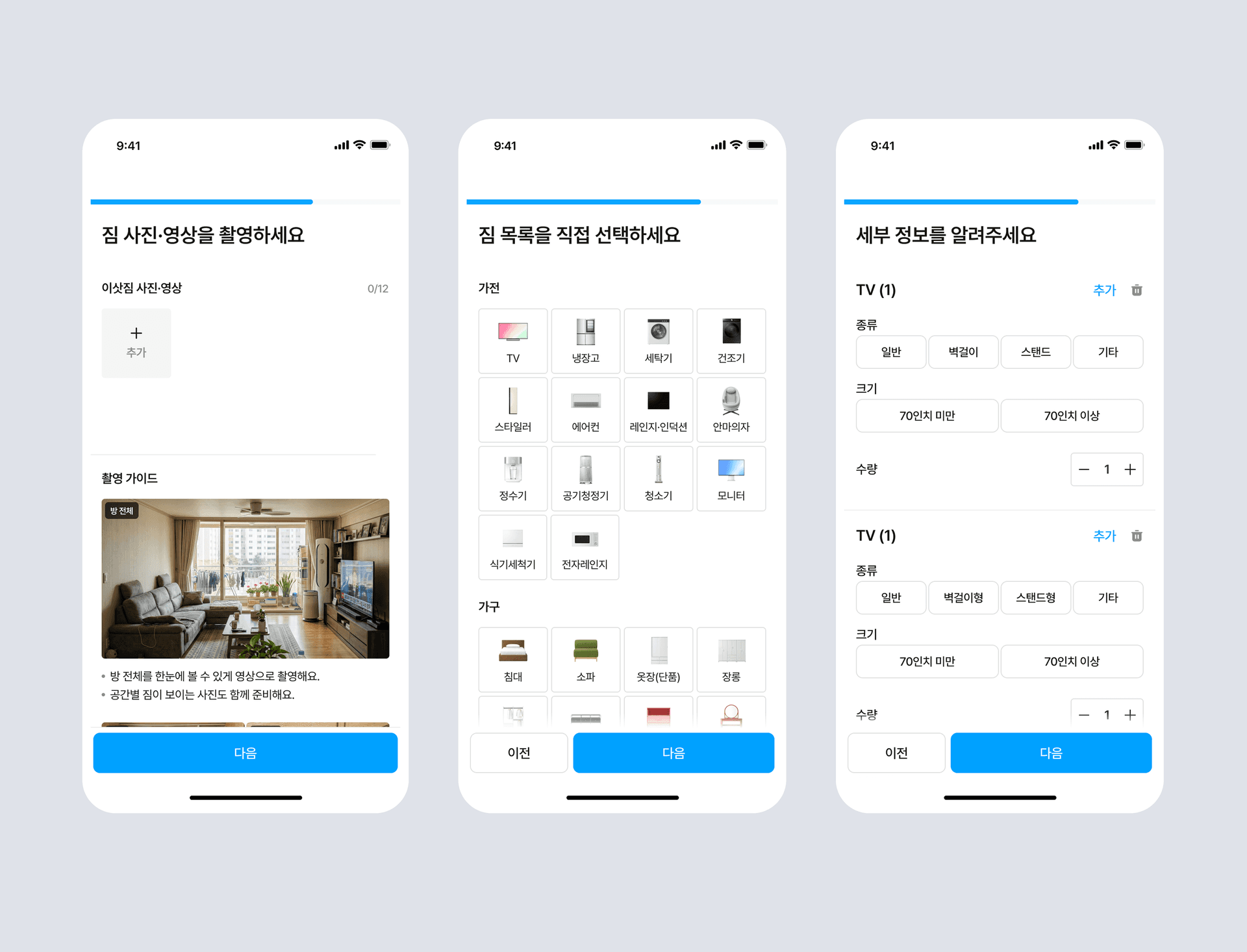
실제로 배포하고 나서 효과를 확인했어요. 배포 후 6일간 데이터를 보면 24시간 이내 수락률이 4.86%에서 5.23%로 6.8% 올랐고, 같은 기간 최고치인 5.30%까지 찍었어요. 같은 기간 신청 건수는 20.8% 줄었는데 수락 건수는 15.3%만 줄었어요. 신청이 더 크게 줄고 수락은 상대적으로 덜 줄면서 수락률이 올라간 구조였죠.
입력 단계가 개인 단위의 신호라기보다 '필터'로 작동해서, 의도가 약한 신청을 사전에 걸러내고 신청 풀 전체의 유효 신청 비중을 높인 결과로 해석했어요.
물론 신청 자체가 20.8% 줄어든 건 계속 지켜봐야 할 가드레일 지표예요. 관측 기간이 6일로 짧아 계약 완료까지 이어지는 전환은 아직 확인 전이고요. 다만 수락 총량은 크게 보전되면서 수락률이 오른 걸 보면, 매칭 시장 전체의 효율은 개선된 방향이었어요.
Acceptance rate within 24 hours
4.86% → 5.23%
*Data for one week after deployment
Total number of acceptances
15.3%
The second side was the customer — making sure customers who need to move get matched with partners offering transparent pricing.
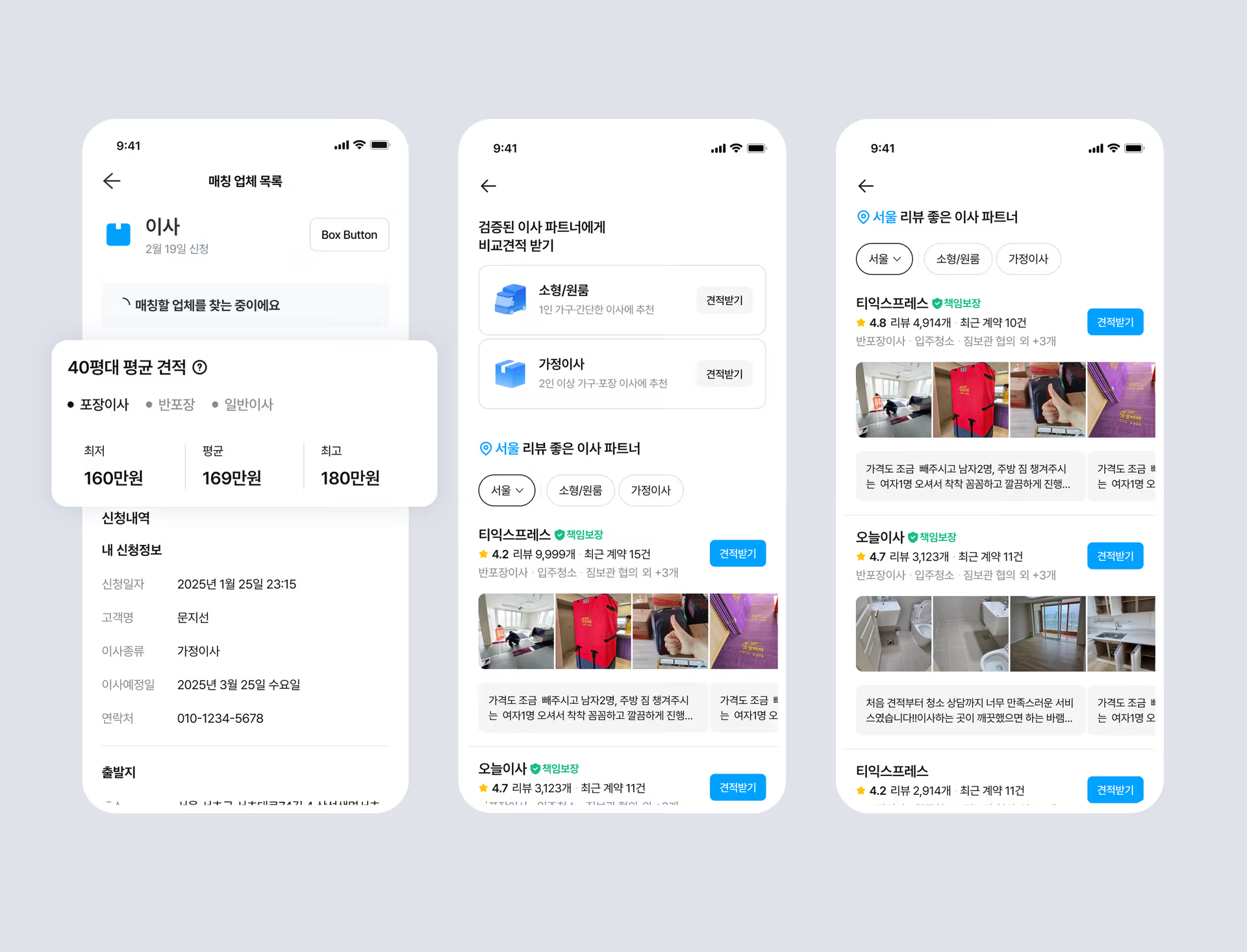
The core of the drip pricing problem was ultimately information asymmetry. Customers had to sign contracts without any way to gauge the final amount. So we decided to surface pricing information right from the matching screen. While customers are browsing partners, we show a low–average–high range up front — something like "average quote for a 40-pyeong home" — based on actual quote data exchanged on Ohouse over the past three years. This lets customers get a rough sense of where their move falls in the market before matching is even complete.
We're also preparing a new feed that lets customers browse partners by region based on ratings and review counts — so that even before clearing the hurdle of entering a quote, before reaching the matching stage at all, they can more directly feel that Ohouse has plenty of quality partners active on the platform.
Once matching is underway, we show each partner's rating, review count, and estimated quote together, and open a direct chat channel for communication. Partners need to feel they can be chosen without hiding information — that's what we believe keeps this transparency-based structure sustainable.
Finding the balance point that satisfies both sides is genuinely difficult. Focus only on partners and you lose customer trust; focus only on customers and partners leave. What the product ultimately had to solve was finding the point where both hold true at once.
Building "a product with two sides of customers" turned out to be a project that taught us this: it's a continuous process of narrowing that intersection.
2026
april, 2026
Nov. 2024

Jun. 2024

Mar. 2024
2026